Bastian Marschner
Co-founder · [role]
[One line of background.]
Force-labelled data for physical AI
FORCEMAP records the force of every finger from a band on the forearm, while people do real work with bare hands. We turn it into training data for general-purpose robots.
Contours: recorded fingertip force from live take 2 · press and hold to add your own
Force barely changes how a hand looks. A firm grip and a light touch are almost the same pixels, so no amount of video, and no model trained to guess force from video, can recover what the hand actually did.
That matters most for the careful, everyday contact a general-purpose robot needs: holding a glass, wiping a table, setting an egg down. Force has to be measured while it happens. It can't be added to a dataset afterwards.
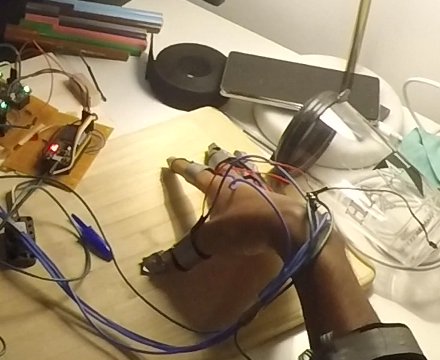
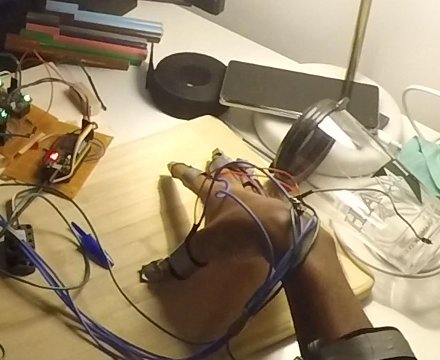
Two frames 2.6 s apart from the take below. Force measured at the fingertip.
Seven pressure sensors in a band on the forearm. A model turns them into the force of each fingertip, 50 times a second. Red is what the model predicted live; white is what the fingertip sensors measured. They're only there to check it.
Per finger r · thumb – · index – · middle – · ring –. One participant, one wearing. The take was never used for training. Offline, on held-out presses, per-finger R² reaches 0.54, in line with the published research benchmark (ForceBand, about 0.45).
A soft band on the forearm and a small head camera. Hands stay bare, so people touch things the way they normally do.
Collectors do real tasks: assembly lines first, then everyday work at home. Full shifts, not studio sessions.
Our models turn the shape and activity of the forearm muscles into each finger's force in newtons, synced to video and hand pose.
Robotics teams train manipulation models on how hard to press, grip and push. The robot uses its own sensors; the band is only for recording.
Our first band reads force from the shape of the forearm muscles: force myography. v1 adds what each misses on its own. EMG catches the electrical activity before a muscle moves, and an IMU separates arm motion from grip. Fused, they hold up across tasks, people and wearings.
Render of the v1 design · drag to rotate · pressure pads driven by recorded force
| v0 · built, Oct 2026 | v1 · in design | |
|---|---|---|
| Force sensing | 8 pressure sensors (FSR) | 32-taxel flex pressure array |
| Muscle activity | – | 8-channel EMG |
| Motion | – | IMU |
| Sample rate | 50 Hz | FMG 100 Hz · EMG 1 kHz |
| Link | ESP32, USB cable | Bluetooth to a phone app |
| Calibration | ~10 min per wearing | Goal: none, from pooled data |
| Ground truth | Fingertip sensors, newtons | Fingertip sensors, newtons |
To make physical AI learn general tasks, scale matters more than accuracy.
Force data today comes from tactile gloves and instrumented rigs. The labels are excellent, but there are only hundreds of hours, because nobody wears that gear through a shift or at home. Language models didn't learn from curated text. Robots won't learn physics from studio sessions.
The error has to be the right kind, though. Force guessed from video is wrong the same way every time, so more video can't fix it. A measured signal carries what really happened, with noise on top, and more data averages the noise away. So the winning sensor is the one people forget they're wearing.
We sell force-labelled manipulation data to teams building general-purpose robots: collections of the tasks you need, and a growing library licensed to many teams.
We start in factories in India, where the work is real and repetitive, and move to everyday household tasks. Collectors are paid well and consent to every recording.
Tell us your tasksCo-founder · [role]
[One line of background.]
Co-founder · [role]
[One line of background.]
Co-founder · [role]
[One line of background.]
Tell us which tasks your model struggles with. We'll scope a force-labelled collection for them.
hello@forcemap.ai